
Why Manager Training Alone Doesn’t Change Behaviour

The Howardco team exploring how intentional leadership and strong manager capability help businesses stay focused during uncertain times.
There's a familiar pattern in most manager development.
A manager goes on a course. The course is well-run. They come back with a folder full of frameworks, some good intentions, and a plan to try things differently. Two weeks later, in the middle of a hard conversation, they revert to what they've always done.
Nothing changes.
We've spent years watching this pattern play out across small and mid-sized Australian businesses, and eventually we had to ask ourselves the honest question: why doesn't training work?
The answer isn't that the training was bad. The answer is that training alone doesn't change behaviour. What changes behaviour is what happens between the sessions: the moment when you actually have to apply what you learned, and someone is there to help you think it through.
Managers don't need more training. They need effective support.
That distinction is why we built The Practical Manager the way we did. And it's why the program looks less like a course and more like a structure for ongoing development.
What we mean by effective support
Effective support is what turns knowledge into behaviour.
It is having someone to text on the morning of a hard feedback conversation, to work through what you're actually going to say. It's a peer group who understands the pressure you're under because they're under it too. It's the coaching moment where a framework you learned six weeks ago finally clicks, because you've now got a real situation to hang it on.
Effective support is the difference between a manager who read about SBI in a workbook, and a manager who's used it, been supported through the awkward first attempt, and turned it into a habit.
Most manager development stops at the training. That's why it doesn't work.
Three habits that show up in the best managers
Over the years, three habits show up consistently in the managers who get the best from their teams. None of them are complicated. All of them are uncommon, because they're hard to sustain without support.
1. They check what landed, not just what they said
Most managers assume that if they said something clearly, the message got through. It usually didn't.
There's a sender, a receiver, and between them a whole lot of interpretation. What you intended isn't the same as what the person heard. That gap is where instructions get missed, deadlines slip, and frustration builds on both sides.
The habit is a single question: after any important message, ask, "Can you tell me what you heard from that?"
Not as a test. As a check.
It surfaces the gap between intention and interpretation before it becomes a problem. And it teaches your team that clarity matters more than agreement.
Most managers don't do it because it feels awkward the first few times. It stops feeling awkward once you've caught a misunderstanding early and saved yourself a week of rework.
The habit is simple. Sustaining it is where support matters.
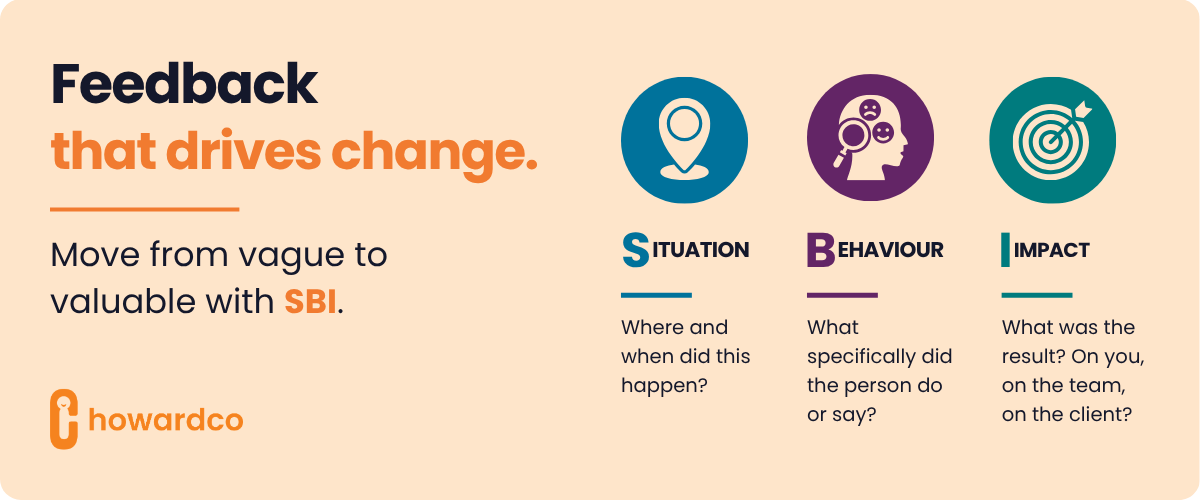
The SBI framework helps managers move from vague feedback to clear, specific conversations by focusing on the situation, behaviour and impact.
2. They give feedback with a structure
Vague feedback is worse than no feedback at all.
If you tell someone they need to "get better" without explaining what better looks like, you've done two things wrong. You've made them anxious. And you've given them no way forward. Most people walk out of that conversation less capable, not more.
The tool we use, and teach, is SBI: Situation, Behaviour, Impact.
Situation: where and when did this happen?
Behaviour: what specifically did the person do or say?
Impact: what was the result? On you, on the team, on the client?
That structure keeps feedback specific. It stops you from generalising ("you're always disorganised") and forces you to point at something you can both look at together.
It also works for positive feedback. "Well done" is fine. "Well done for staying an extra hour on Tuesday to help the new hire get through the report, it gave me the confidence to send it to the client without a rewrite" is unforgettable.
Structure isn't the enemy of warmth. It's what makes warmth land.
Knowing SBI is easy. Reaching for it in the moment, when your first instinct is to be vague and polite, is the part that takes practice. That's where support comes in.
3. They diagnose before they act
When someone on your team isn't performing, the temptation is to jump to a fix. Talk to them. Give them a plan. Send them on a course.
The problem is that most performance issues have different root causes, and the fix that works for one won't work for another. Before you act, diagnose.
We use three categories:
Will: they know how to do the job, but they're not. Something has drained their motivation.
Skill: they want to do it, but they don't have the tools or training.
Drill: something deeper. Attitude, values misalignment, an unspoken issue you haven't named yet.
If it's skill, coaching or training will help. If it's will, you need to understand what changed. If it's drill, no amount of training will fix it. You need to have the harder conversation about what's actually going on.
Managers who skip the diagnosis end up spending months trying to fix the wrong thing. Managers who diagnose first often find the issue is smaller, or bigger, than they first thought, and address it in weeks instead of months.
The diagnosis is often the hardest part. Not because it's technically difficult, but because being honest about what's actually going on requires courage. That courage is easier to find when you have peers you can talk it through with.
Why this matters more than it used to
Managers today are asked to do more than at any point in recent memory. They're navigating hybrid teams, generational shifts, rising expectations from above and below, and doing it with almost no training in the actual craft of managing.
According to Gallup's State of the Global Workplace research, only 44% of managers globally have received any formal management training. Manager engagement fell from 27% to 22% in 2025, the steepest engagement decline of any group in the workforce. And managers, Gallup's research shows, account for 70% of the variance in team engagement.
Australia's own 2026 HR Trends report named developing supervisors and team leaders as the highest-return investment SMEs can make, because "management behaviour is the primary driver of employee culture and business performance."
The data tells a story most managers already feel. They're carrying more, with less preparation, than any previous generation of managers. And most of them are trying to figure it out alone.
Training alone isn't enough to close that gap. Effective support is.
What we've built
The Practical Manager Experience is our free, live 90-minute session. It's how we introduce people to what peer-based development actually feels like, not a webinar, not a sales pitch, but a working session with other managers doing the job. We run it a few times a year.
The Practical Manager is our full program. Six modules over six months, live online, covering communication, feedback, underperformance, conflict, and accountability. Peer group sessions run between each module. That's where most of the learning actually happens: not in the sessions themselves, but in the conversations between them.
That's the model. That's why it works.
Where’s the biggest gap in your management? A quick self-check can help you identify where to focus first.
Before you go
Wondering where the biggest gap is in your own management? We built a free self-check that covers all five capabilities we see across our client work. It gives you a starting point, a score, and one thing to do this week.
Download the Management Gap Self-Assessment Checklist →
If you'd like to talk about whether The Practical Manager is right for you or your team, click here to email us or book a free 20-minute call.
Join our live, online manager development program. It is built for managers who are good at their jobs but were never shown how to manage people.
Frequently Asked Questions
Why are peer discussions useful in manager development?
Managers often discover that people in different organisations are facing very similar challenges. Peer discussions give them access to perspectives, questions, and practical ideas they may not have considered on their own. They also make it easier to talk honestly about situations that can feel isolating when handled alone.
How can a business tell whether manager development is working?
Look for changes in day-to-day behaviour, not just course completion. Useful signs may include clearer expectations, earlier conversations about performance, fewer repeated misunderstandings, stronger ownership within the team and managers becoming less reliant on senior leaders to solve every people issue. TPM participants use a Manager Impact Tracker to record these changes over time.
Who is The Practical Manager designed for?
The Practical Manager is designed for people who manage teams and want practical ways to communicate clearly, give feedback, address underperformance and handle everyday people issues with greater confidence. It can also support business owners and senior leaders who want to strengthen the capability of their managers.
How is The Practical Manager different from a one-off course?
The Practical Manager runs over six months and combines live online modules with peer group sessions between them. This gives participants time to apply what they learn, bring real situations back to the group and build the habits gradually rather than trying to absorb everything in a single session.